King Radios · Wildland Fire Communications
Best Radios for Wildland Firefighters: A Practical Buying Guide
A radio can have a long list of features and still be the wrong choice for a wildland assignment. Start with the incident's communications requirements, then choose the equipment that can meet them.
Wildland firefighters ask a great deal of a portable radio. It needs to be understandable in a noisy environment, practical to operate with gloves, ready for a long shift, and compatible with the channels assigned to the incident. For federal interagency work, it also needs to meet the applicable fire-radio approval requirements.
That is why there is no single “best radio” for every firefighter. A contract crew working on VHF assignments may be well served by a BKR5000. Someone coordinating with agencies on VHF and regional 700/800 MHz systems may need a properly configured BKR9000. An agency replacing older radios must also account for programming tools, spare batteries, serviceability, and the support available at incidents.
This guide looks at those decisions using the June 16, 2026 National Interagency Incident Communications Division (NIICD) approved-radio list, current BK Technologies information, and the equipment offered by King Radios.
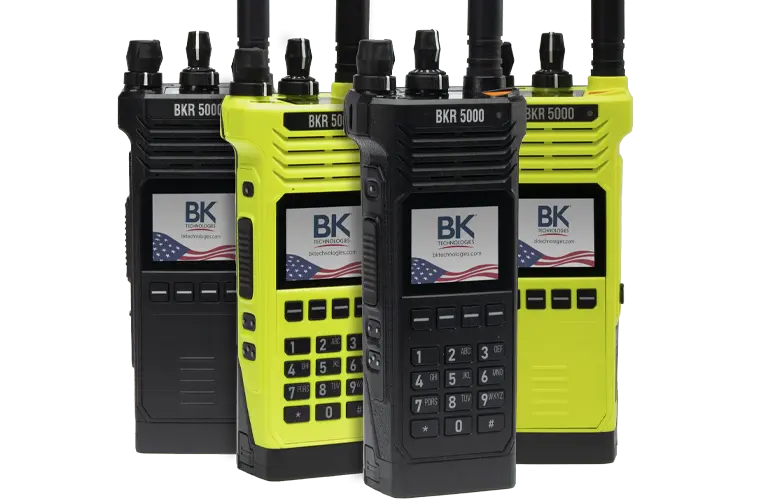
BKR5000
A sensible starting point for crews using VHF channels and seeking a current NIICD-supported radio model.
Explore BKR5000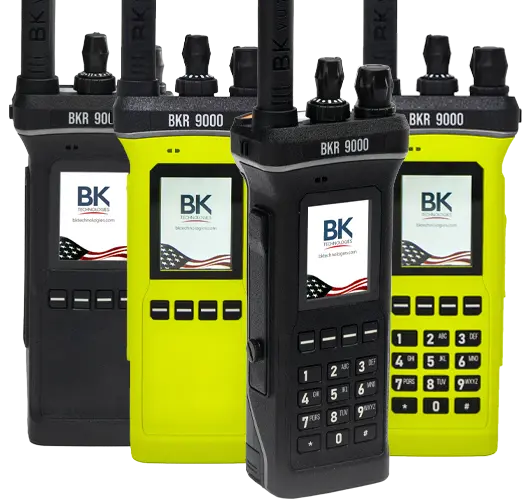
BKR9000
For approved users who need VHF plus other radio bands and can manage their own incident programming support.
Explore BKR9000Product photographs hosted by King Radios. The illustrated radios represent product families; features and enabled frequency bands depend on the ordered configuration.
Which Wildland Fire Radio Should You Buy?
If you need a practical shortlist, begin with these options. They are not ranked by advertised range or price; each serves a different operating requirement.
BKR5000
A strong current choice where assignments are VHF-focused. It appears on NIICD's supported-radio list. Check the exact model, channel-control configuration, and fire-agency requirements.
BKR9000
Worth evaluating where authorized personnel need VHF, UHF, or 700/800 MHz operation. Required band options must be enabled; NIICD approval does not mean NIICD will support the radio at an incident.
Legacy P25 radios
Some KNG and DPH models remain on the approved list, but NIICD support and manufacturer parts availability are changing. A still-approved radio is not necessarily a sensible new purchase.
Other approved makes and models exist, including specific Motorola APX-series portables. The federal list does not require a particular brand. What matters is the approved configuration, the incident's radio plan, and the support you can actually provide.
What Makes a Good Radio for Wildland Firefighting?
Look beyond the highest wattage or the longest range claimed on a product page. A dependable field radio must fit the way people work on a fire.
| Requirement | What to check before buying |
|---|---|
| Approved for your assignment | Current NIICD fire approval, model-specific remarks, and any employer or contract restrictions. |
| Correct operating band | VHF for the assigned channels; any other bands only where the operation requires and authorizes them. |
| Incident programming | Ability to load or edit authorized channels and codes with the required tools and trained personnel. |
| Simple field controls | Glove-friendly PTT and knobs, readable channel labels, reliable volume adjustment, accessible emergency functions. |
| Power for the full assignment | Rechargeable batteries, spare packs, AA clamshell options, charger power, and a documented replacement plan. |
| Field resilience | Ingress protection, suitable carrying equipment, protected antenna and audio connections, and service support. |
| Clear audio | Intelligibility with wind, pumps, engines, and protective clothing; compatible speaker microphones. |
One practical question deserves a place near the top: Who will make the radio ready for the next incident? The answer may be your department technician, a dealer, or a qualified incident communications specialist. It should not be left until check-in.
NIFC and NIICD Radio Approval: What the Labels Actually Mean
The National Interagency Fire Center (NIFC) is often mentioned in radio listings, while the formal national fire-radio list is published by the National Interagency Incident Communications Division (NIICD). The June 16, 2026 NIICD approved-radio list is the primary source to consult for federal interagency wildland fire use.
“Fire approved” and “NIICD supported” are different
An approved radio meets the applicable evaluation requirements. A NIICD-supported radio is one for which the National Interagency Incident Radio Support Cache (NIRSC) provides specified programming, cloning, documentation, and technical support. NIICD explicitly states that approval is not a purchase endorsement.
From the June 2026 list: The BKR5000 is listed among NIICD/NIRSC-supported VHF P25 portable radios. The BKR9000 appears on the nationally approved VHF portable list when its single-, dual-, or multi-band VHF option is installed, but is not listed as an NIICD-supported model.
That difference affects privately owned equipment. NIICD says users of approved but unsupported radios are responsible for the required software, programming/cloning cables, training, technical support, and troubleshooting. They must be capable of configuring their radios for changing incident assignments.
The same 2026 document notes that NIICD support for the KNG2-P150 and DPHX5102X is scheduled to end after 2026, even though those radios still appear on the approved list. It also identifies the DPHX5102X as an end-of-life model. Those details matter to anyone buying used inventory.
Don't confuse national approval with a preloaded channel list
Buying an approved model does not mean it arrives programmed for every future fire. Incident channel and talkgroup assignments must come from the responsible communications organization. The Incident Radio Communications Plan (ICS 205) is used to document assignments for an operational period.
Check the current list whenever you order. Approval documents, support classifications, system requirements, and model options may change.
The Main Radio Options: BKR5000, BKR9000, and Older P25 Models
BKR5000: A Current VHF-Focused Choice
The BKR5000 VHF P25 portable operates on 136–174 MHz and supports analog and P25 conventional operation, with additional P25 trunking capabilities available by configuration. It offers up to 5,000 channels, field-oriented controls, and a high-capacity rechargeable battery option.
For a crew that only needs VHF, there is no reason to buy extra frequency bands simply because another model offers them. The BKR5000 also has an important practical advantage: its place in NIICD's supported-radio category.
King Radios offers several wildland fire radio packages built around the BKR5000, including choices with antennas, clamshell battery cases, and other accessories.
BKR9000: Useful When the Job Involves Multiple Bands
The BKR9000 portable can be configured for VHF, UHF, and 700/800 MHz systems. It supports P25 conventional and trunking capabilities, subject to the enabled options and required system authorizations. A multi-band-capable case does not mean all frequency bands are active when shipped.
Consider it for supervisors, mixed-agency operations, or departments preparing for a defined network change. Ask which bands are enabled, which additional features cost extra, and who can support programming in the field. The radio's NIICD approval does not make it an NIICD-supported cache model.
Older KNG and DPH Radios: Useful References, Not Automatic New-Buy Recommendations
Existing KNG-P150, KNG2-P150, and DPHX5102X radios may still have a place in working fleets if they satisfy the current incident requirements and remain supportable. But the age of a radio matters when replacement batteries, programming equipment, and factory repairs become harder to obtain.
King Radios maintains a KNG2-P150 reference page for users identifying or managing older equipment. Treat discontinued product listings as references rather than evidence of current stock.
What About Other Manufacturers?
The NIICD list also identifies approved Motorola portable models, including specified APX6000 and APX8000 variants, alongside other models. Some entries include configuration, software, or incident-support qualifications. These are legitimate alternatives for agencies whose radio infrastructure, contracts, or fleet standardization already point to those products.
A sensible comparison is between approved configurations that can be programmed, supported, and supplied—not between brand names in isolation.
VHF vs. UHF vs. Multi-Band: Which Do Wildland Firefighters Need?
For many interagency fireline operations, VHF-FM is the important starting point. But not every participating organization uses the same system for every task. County services, municipal departments, and command personnel may also work with UHF or regional 700/800 MHz networks.
Radio Band Compatibility
BKR9000 bands require the relevant purchased activation. Band capability does not guarantee system permission, simultaneous operation, or greater range.
The BKR9000 can reduce the number of separate radios some personnel need to carry. But it does not automatically bridge two agencies' networks or replace an interoperability plan. Each system still needs compatible programming and authorization.
Choose the band first, then the radio. A properly programmed VHF-only portable is more useful to a VHF assignment than an expensive multi-band portable without the correct VHF option, antenna, or current channel plan.
The Overlooked Requirement: Programming and Cloning at an Incident
Programming is one of the biggest differences between owning an approved radio and arriving with an operational radio. Assigned channels can change between incidents and operational periods. A familiar radio that cannot accept the required authorized configuration is not ready for the assignment.
What to check before deployment
For privately owned radios that are approved but not NIICD-supported, the June 2026 list places programming and support responsibilities on the owner. That means planning for compatible software, cables, trained operators, and a way to troubleshoot problems without depending on cache staff to do it.
The 2026 NIICD User's Guide contains BKR5000/BKR9000 operating and programming references. Follow the responsible communications unit's directions and applicable authorization rules; do not load or transmit on frequencies simply because they appear in an online list.
Front-panel programming vs. fleet programming
Front-panel programming can be valuable where it is permitted and correctly configured. For larger fleets, consistent templates and controlled cloning can reduce setup mistakes. Neither method removes the need for an approved channel plan and a qualified person to verify it.
Range in Mountainous Terrain: What Wattage Won't Tell You
Two radios rated at the same transmitter power can perform very differently depending on terrain, antenna placement, receiver characteristics, repeater coverage, and how they're used. A ridge can block a direct path; a well-placed repeater may extend coverage far beyond a portable-to-portable conversation.
The BKR5000 and BKR9000 each offer up to 6 watts of VHF transmit power in their relevant configurations. That specification is useful, but it does not produce a reliable mileage promise.
Before spending more to solve a range problem
- Identify whether the issue occurs on direct/tactical channels or through a repeater.
- Confirm the specified antenna is correct for the radio and operating band.
- Check how carrying position, damaged connectors, and a worn antenna may affect the link.
- Review the planned repeaters and the incident communications arrangements.
- Ask a qualified radio technician to evaluate persistent coverage or receiver problems.
Buying the BKR9000 because it has more bands will not, by itself, fix weak coverage on a VHF channel. Bands provide compatibility options; the complete radio system determines practical coverage.
Battery Planning for Extended Wildland Fire Assignments
Published battery life is measured under defined operating conditions. On a fireline, frequent transmission, scanning, temperature, accessory use, and battery age can change the result considerably.
King Radios describes the BKR5000 with a 4,900 mAh smart lithium-ion battery and more than 12 hours of rated use under specified conditions. BK Technologies describes the BKR9000 as exceeding 12 hours under its 5/5/90 duty-cycle test. Neither figure guarantees a full shift in every setting.
Rechargeable batteries and AA clamshells serve different needs
A rechargeable battery is convenient when crews have dependable access to charging. An AA clamshell can offer a backup option where charging is difficult, provided the exact case and cell type are approved for that radio.
Do not assume a BKR5000 battery works in a BKR9000. Order spare packs, clamshells, and chargers by the correct part number. Some charging products serve both models, while battery cases and packs can differ.
Field planning tip: Build a power plan around the entire assignment: charged primary battery, properly stored spare, an approved backup-power option, and enough charging capacity to reset the fleet for the next operational period.
Durability, Glove-Friendly Controls, and Clear Audio
Durability is more than surviving a rainstorm. Fire crews need radios they can operate predictably while working with gloves, protective clothing, moving equipment, and other noise.
The BKR5000 is listed with IP68 ingress protection. BK Technologies' October 2026 BKR9000 specifications list IP64 as standard and IP68 as optional. The rating of the actual supplied configuration matters more than an unqualified “waterproof” claim in a retail listing.
When comparing models, evaluate the physical channel selector, emergency control, volume knob, speaker-microphone connection, display visibility, and carrying setup. A full keypad may be useful for authorized field functions; some roles may be better served by fewer controls and a standardized channel plan.
Test the audio with actual protective equipment
Where possible, assess intelligibility with the type of helmet, clothing, vehicle noise, pumps, and wind exposure your personnel encounter. Check whether the chosen speaker microphone can be mounted where the user can reach it without interfering with other protective gear.
No radio or audio accessory can substitute for a communications plan, listening discipline, and established emergency procedures.
What Should a Complete Wildland Fire Radio Kit Include?
A radio price can look reasonable until antennas, batteries, audio accessories, and programming needs are added. A useful kit should be specified around the assignment rather than assembled from whatever items are easiest to bundle.
- Approved radio with the correct band and channel-control configuration
- Suitable antenna for the operating band and intended use
- Rechargeable battery and, where appropriate, approved AA clamshell backup
- Compatible charger and a plan for field power availability
- Speaker microphone and carrying arrangement appropriate for PPE
- Required authorized programming software, cables, and qualified support
- Model-specific quick reference, labeling, and a pre-deployment function check
King Radios has a dedicated Fire and Forest Service Radio Packages page. Its listed BKR5000 kits offer different combinations of antennas, AA clamshells, microphones, and optional rechargeable power equipment.
For individual components, browse BKR5000/BKR9000 accessories. The availability and fit of each part should be confirmed against the radio's model and configuration.
Don't buy an antenna based on length alone
Longer antennas aren't automatically the right choice. Frequency coverage, intended mounting, compatibility, durability, and the practical operating environment all matter. A multi-band radio may require a different antenna from a VHF-only unit.
Are Older KNG and DPH Fire Radios Still Worth Using?
Many departments still own older radios that have served them for years. A model appearing on the approved list does not mean it is the best choice for a new procurement.
NIICD's June 2026 document indicates that support for the KNG2-P150 and DPHX5102X ends after 2026. It also places the DPHX5102X in its end-of-life category, with a date of May 8, 2026. The document describes separate rules for how end-of-life models remain on the approval list, so do not treat the end of support as an immediate ban.
For a fleet that already owns those radios, review current approval, battery and antenna condition, parts availability, firmware requirements, programming capability, and repair costs. For a new fleet purchase, a current-generation radio is often easier to justify than building around equipment with a shrinking support path.
If you need to identify an older model, King Radios retains KNG2-P150 specifications for reference.
Pricing: Compare the Whole Working Package
For a contractor buying a few radios, individual purchase price matters. For a department purchasing a fleet, the cost of accessories, programming, training, spare units, and service support can matter just as much.
King Radios listed the following BKR5000 VHF trunking portable configurations during this November 2026 review:
| King Radios listing | Published price | Buying note |
|---|---|---|
| BKR5000 Tier 1 | $2,350 | Confirm model, keypad, and included equipment. |
| BKR5000 Tier 2 | $2,675 | Review available controls and options. |
| BKR5000 Tier 3 | $2,875 | Review full-keypad and configuration requirements. |
| BKR5000 Basic Radio Package C | $2,875 | Package with listed antenna and AA clamshell components; confirm current contents. |
Prices are publicly displayed examples as reviewed in November 2026, not a guaranteed quote. Product listings, configurations, included accessories, and availability may change. Some pages may describe components or upgrades differently; confirm the exact SKU and itemized package before ordering.
BKR9000 pricing varies with interface tier, enabled frequency bands, environmental options, and other features. Request a written quote comparing the complete usable package, not only the radio chassis.
Warranty is also worth comparing. King Radios' published warranty summary lists two years on the BKR5000 basic radio unit and five years on the BKR9000 basic radio unit, with separate terms for batteries and other accessories.
Lead times: On November 12, 2026, BK Technologies reported that a production interruption was delaying some BKR9000 shipments into 2027. This does not establish any dealer's inventory. If you have a seasonal deployment deadline, ask King Radios to confirm the exact configuration and delivery date in writing.
For multiple units or government purchasing, King Radios provides department and government sales support.
Which Radio Fits Your Assignment?
| Buyer or assignment | Best starting point | Verify before ordering |
|---|---|---|
| Contractor working on VHF-based interagency fires | BKR5000 | Current NIICD list, the specific channel selector/control layout, programming and backup power. |
| County fire command coordinating on VHF plus other agency bands | BKR9000 | Enabled bands, antenna, trunking options, system permissions, and independent programming support. |
| Department replacing an older KNG or DPH fleet | Current BKR5000 or suitably configured BKR9000 | Actual systems, accessory replacement costs, programming migration and service availability. |
| Agency standardizing one radio across varied assignments | Evaluate both; consider multi-band only where required | Approval and support categories, fleet templates, operator training, and full ownership cost. |
| Personnel already issued an approved older radio | Retain only if fully compliant and maintainable | 2026 support changes, end-of-life status, repair capability and incident programming. |
The best answer may vary within a single department. Crew members using only VHF channels may have different equipment requirements from a communications supervisor who routinely moves between networks.
The Pre-Purchase Checklist
Before issuing a purchase order, get clear answers to these questions:
- Approval: Is the specific model and configuration on the latest applicable NIICD list?
- Support: Is it NIICD-supported, or must our organization supply programming and technical support?
- Band: Which frequencies and radio systems will personnel actually use?
- Authorization: Who grants access to any trunked or encrypted system?
- Controls: Will the operator need a full keypad, a particular channel selector, or a simpler interface?
- Power: How many charged batteries, spare packs, approved AA cases, and chargers are required?
- Accessories: Which antennas, microphones, cases, and cables are compatible by part number?
- Programming: Who will update incident channels and verify the radio before use?
- Life cycle: What warranty, repair, software, and parts support will be available?
- Delivery: Is the exact configured equipment available before the needed deployment date?
The buying decision in one sentence: Choose the radio that can be correctly configured and supported for the assignments you actually work—not the radio with the longest specification sheet.
Frequently Asked Questions
What is the best radio for wildland firefighters?
For many VHF-focused operations, the BKR5000 is a strong current choice, particularly because it is an NIICD-supported model. The BKR9000 may be a better match for personnel who need multiple authorized frequency bands. Requirements and support arrangements should decide the purchase.
Is the BKR9000 approved by NIFC?
The NIICD June 2026 national fire approved list includes the BKR9000, with the relevant VHF band option installed for VHF use. It is not in NIICD's supported-cache category, so owners need an independent programming and support plan.
Does an approved radio come programmed for an incident?
No. Approval does not guarantee that the radio is loaded with the channels or system configuration assigned for a particular incident. Follow the responsible communications unit's ICS 205 and instructions.
Do wildland firefighters need P25 radios?
Many federal interagency assignments and contracts specify P25 digital requirements. Whether a particular assignment needs P25, analog operation, or both depends on the relevant rules and communications plan. Verify requirements rather than relying on a generic “fire radio” label.
Will a higher-wattage portable have better range?
Not necessarily. Terrain, antenna, receiver characteristics, repeater coverage, and correct system setup are critical. More watts alone cannot overcome all coverage limitations.
Are KNG2-P150 and DPHX5102X radios still approved?
Both appear on the June 2026 list, but NIICD notes that its support for these models ends after 2026. The DPHX5102X is also identified as end-of-life. Consult the latest document before relying on an older model for future incidents.
Should contractors buy a radio or a ready-made kit?
Compare the contents. A well-specified kit can simplify purchasing if it includes the exact required radio, antenna, power options, and accessories. But verify programming responsibilities and whether each component is compatible and necessary for your assignments.
Can the BKR5000 and BKR9000 communicate with each other?
Yes, if the BKR9000 has the necessary VHF option enabled and both radios are properly configured for compatible, authorized VHF communications. Multi-band capability does not automatically grant access to other agencies' systems.
Final Thoughts: Buy for the Incident, Not the Advertisement
The strongest wildland fire radio purchase starts with the approved-radio list, your assignment's frequency requirements, and a realistic plan for keeping every radio programmed and powered. For a VHF crew, the BKR5000 is usually the first model worth evaluating. For a user who genuinely needs several frequency bands, a correctly equipped BKR9000 may make sense—but its support requirements deserve extra attention.
Older radios can remain useful when they are still approved, configured correctly, and maintainable. For new fleet investments, however, support life and available parts should carry as much weight as any headline feature.
Need a Wildland Fire Radio Package?
King Radios can help compare BKR5000 and BKR9000 configurations, review accessories, and prepare an itemized quote for individual buyers, departments, and agency purchasing teams.
Call 541-621-4588 or use the contact page to describe your radio model, quantity, assignment requirements, and delivery schedule.
View Wildland Fire Radio Packages Contact King RadiosOfficial Sources and Further Reading
- NIICD — National Fire Approved Radios, June 16, 2026 (PDF). Primary authority for approval, supported status, and end-of-life remarks.
- NIFC — NIICD Documents. Check for newer approval lists, guides, and current operational references.
- NIICD — 2026 User's Guide (PDF). Portable operation and programming information, including BKR5000/BKR9000 sections.
- NWCG — ICS Forms. Incident Radio Communications Plan (ICS 205) reference.
- BK Technologies — BKR5000 product information.
- BK Technologies — BKR9000 Specifications, revised October 2026 (PDF).
- BK Technologies — Third Quarter 2026 Results, November 12, 2026. Includes the BKR9000 production and shipping update.
Editorial and technical source review: November 2026. This buying guide is not a substitute for current agency requirements, an approved incident communications plan, or qualified radio-system support. Specifications, prices, approved lists, and availability can change.