King Radios / Public Safety Communications Guide
P25 Phase 1 vs. Phase 2: Differences, Compatibility, and Which System Do You Need?
The choice between P25 Phase 1 and Phase 2 is usually a question of capacity—not which radio is newer, louder, or capable of reaching farther.
A department looking at new P25 radios often runs into the same question: Do we need Phase 2? The answer depends on the network you use, how busy that network gets, and whether existing radios can still do their jobs. Buying a Phase 2-capable handheld by itself does not upgrade a radio system.
P25 Phase 1 allows one voice path on a 12.5 kHz radio channel. Phase 2 can carry two voice conversations on that same 12.5 kHz channel by assigning alternating time slots on a trunked system. That increases the potential number of simultaneous calls without adding frequencies. It does not automatically improve terrain coverage or give one agency access to another agency's system.
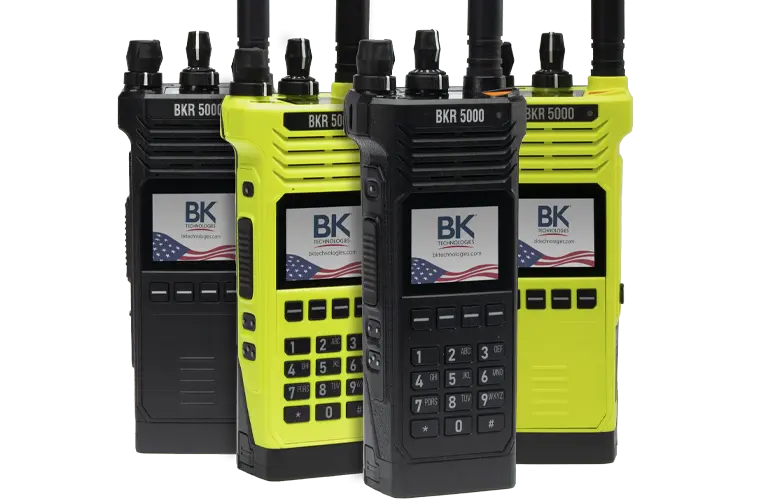
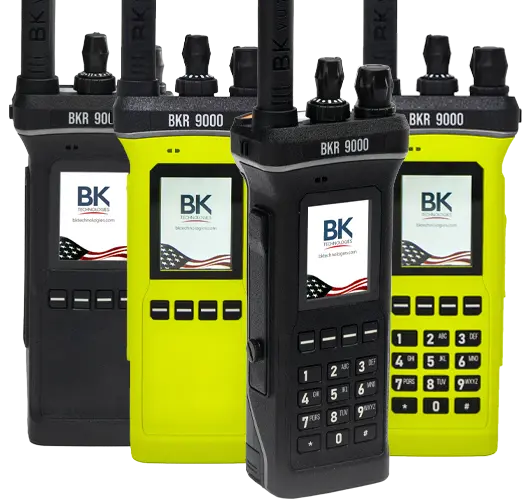
Product photographs are hosted in the King Radios WordPress Media Library. Actual radio configuration and enabled features depend on the ordered model.
What Is Project 25 (P25)?
Project 25, or P25, is a set of open standards for digital land mobile radio communications. Public safety agencies use P25 to define how compatible radios and network equipment communicate, with the aim of making equipment from different manufacturers work together under established standards. The standards are developed through a user-led process and published by the Telecommunications Industry Association (TIA). APCO explains the P25 standardization process.
P25 is not one radio model or one national radio network. Two radios can both be advertised as P25 yet operate on different bands, lack the same trunking features, or be unauthorized on the same regional system. That distinction becomes critical when moving from Phase 1 to Phase 2.
P25 Phase 1 vs. Phase 2: Side-by-Side Comparison
| Buying question | Phase 1 | Phase 2 |
|---|---|---|
| How does it share RF capacity? | FDMA (one voice path per 12.5 kHz channel) | Two-slot TDMA (two potential voice paths per 12.5 kHz trunked traffic channel) |
| Physical RF channel bandwidth | 12.5 kHz | 12.5 kHz; 6.25 kHz-equivalent efficiency per voice path |
| Conventional P25 voice | Yes | Not as Phase 2 TDMA; conventional P25 voice uses Phase 1 FDMA |
| Trunked P25 voice | Yes | Yes, on compatible infrastructure |
| Maximum voice paths on one traffic channel | One | Two, under suitable operating conditions |
| Older Phase 1-only subscribers | Can use compatible Phase 1 resources | Cannot transmit Phase 2 TDMA; system needs a supported fallback or parallel Phase 1 mode |
| Main reason to specify it | Conventional operation or adequate Phase 1 trunked capacity | Additional trunked voice capacity and spectrum efficiency |
| Does it automatically increase range? | No | No |
| Does the handset alone change the network? | No | No |
This table describes the standard's common voice modes, not a promise that every vendor implements every optional feature. See the Project 25 Technology Interest Group FAQ and APCO's air-interface overview.
FDMA vs. TDMA: How the Two Phases Actually Work
The important difference is when the radio gets to use a channel. Phase 1 gives one active conversation a 12.5 kHz channel. Phase 2 divides access to that same channel into rapidly alternating time slots, allowing two separate conversations to share it.
Original illustration for King Radios. Time slots are simplified and not to scale. Phase 2's 6.25 kHz equivalence is a capacity measure; the actual RF channel remains 12.5 kHz wide.
Phase 1: One Conversation per Traffic Channel
In a Phase 1 trunked system, the controller assigns a free traffic channel to a talkgroup when a user presses push-to-talk. During the transmission, that traffic resource carries one conversation. A conventional Phase 1 channel is different: users operate on their assigned channel instead of waiting for a trunking controller to assign one dynamically.
Phase 2: Two Voice Paths on the Same Traffic Channel
Phase 2 TDMA makes more efficient use of a trunked traffic channel. One call uses one time slot while another call uses the other. Users still press the push-to-talk button normally; the radio and infrastructure handle the timing.
It is easy to describe Phase 2 as creating a second channel, but technically the system is reusing one 12.5 kHz RF channel more efficiently—not obtaining another licensed frequency.
When Does the Extra Capacity Actually Help?
Think about a regional system that handles routine fire, law enforcement, emergency medical, and public works traffic. Most days, available channels may be sufficient. During a large storm or major multi-agency response, several talkgroups may be active at once. If all the available voice resources are already occupied, the next call may be queued or denied depending on how the network is designed.
That is the problem Phase 2 is meant to help solve. Using two voice slots per eligible traffic channel can increase the number of simultaneous calls that the same spectrum can support.
For illustration, all three channels are assumed to be traffic resources available for voice. Real systems also have control-channel, site, equipment, mixed-mode, and traffic-engineering constraints.
The capacity benefit is substantial in the right setting, but it is not unlimited. A system engineer should examine busy-hour call records, blocked or queued calls, talkgroup activity, the number of RF sites, licensing, and failover requirements. A rural system with light traffic may have little practical reason to move purely for a theoretical doubling of voice paths.
Conventional vs. Trunked P25: The Distinction Buyers Miss
This is one of the most important parts of the decision. Phase 2 TDMA is a P25 trunked voice mode. A conventional P25 system continues to use Phase 1 FDMA voice. Direct radio-to-radio or talk-around P25 voice likewise uses the Phase 1 mode.
Users share an assigned channel
Crews select their programmed frequency or channel and communicate directly or through an appropriate repeater. This approach is common where systems are simpler or direct-mode communications matter.
The network assigns a traffic resource
Users select talkgroups while a controller assigns available traffic channels. Phase 2 TDMA can create two voice paths per eligible traffic channel in that trunked network.
The distinction is about the network architecture. A Phase 2-capable portable can still use Phase 1 conventional channels when properly configured.
For wildland fire crews whose assignments rely on conventional VHF channels and approved incident communications plans, Phase 2 trunking capability may be useful elsewhere but is not what changes their conventional fireground communications. See King Radios' public safety and wildland fire radio packages for an equipment-focused starting point.
Can Phase 1 Radios Work on a Phase 2 System?
Sometimes, but not simply because both devices have “P25” printed in their specifications.
A newer Phase 2-capable radio is generally designed to support applicable Phase 1 modes. A Phase 1-only radio, however, cannot decode or transmit Phase 2 TDMA voice traffic. To keep older subscribers in service, the trunked system must support an appropriate Phase 1 voice mode, and that fallback has to be enabled and correctly configured for the specific users and talkgroups.
Some systems can use dual-mode or dynamic switching arrangements. Others may require that particular talkgroups remain Phase 1. The actual behavior depends on network equipment and configuration; it should never be assumed without confirmation from the system administrator.
An older Phase 1 subscriber needs a supported FDMA voice path. The drawing is a capability illustration, not a guarantee that a given trunked system enables dual-mode operation.
What to Check Before Keeping Older Radios
- The exact frequency band and hardware model of each portable and mobile radio.
- Whether the network supports Phase 1 traffic resources alongside Phase 2.
- Which talkgroups permit Phase 1 operation and which are TDMA-only.
- Firmware, trunking features, encryption options, and programming templates.
- System administrator approval and successful on-network testing.
Compatibility should be demonstrated on the intended system before a department commits to a mixed fleet.
Will Phase 2 Improve Range, Audio Quality, or Battery Life?
Coverage: Not Automatically
Phase 2 mainly addresses capacity. Geographic coverage depends on radio frequency, infrastructure design, tower locations, antenna systems, receiver performance, terrain, buildings, interference, and simulcast timing. A department struggling to talk from inside concrete buildings should investigate coverage engineering rather than treating TDMA as the fix.
Voice Quality: Depends on the Whole System
Both phases support digital public safety voice communications. Real-world intelligibility also depends on microphones, vocoders, noise conditions, network design, and audio accessories. Switching phases does not guarantee that speech in a loud engine bay or on a fireground becomes clearer.
Battery Life: A Possible Benefit, Not a Guaranteed Runtime
Phase 2 TDMA transmits in assigned time slots, which can reduce transmitter duty cycle during a call and help portable battery performance under certain conditions. The actual gain depends on the radio hardware, system mode, battery, talk time, scanning, display use, and other settings. Compare manufacturer duty-cycle test conditions rather than accepting a universal battery-life percentage.
Practical test: Ask for coverage maps and drive-test or in-building measurements separately from busy-hour traffic figures. A department may need better coverage, more voice capacity, or both—but those problems have different solutions.
Encryption, Programming, and Network Access
P25 Phase 2 is not synonymous with encrypted communications. A Phase 1 network can use supported encryption, and a Phase 2 network may carry unencrypted traffic. Encryption algorithms, key management, radio authentication, over-the-air rekeying, and interoperability requirements must be specified separately.
Likewise, “P25 Phase 2 capable” on a product page does not mean that every optional feature is installed. Some radios need trunking licenses or software activation. Others may require specific firmware, programming tools, radio IDs, or authentication credentials.
Before purchasing, request an itemized description of included versus optional functionality. For a multi-agency deployment, include the neighboring system's requirements and any restrictions on authorized talkgroup access.
Which King Radios Equipment Supports These P25 Requirements?
When selecting subscriber equipment, start with the system's operating band and architecture. Then match the portable or mobile radio and the required trunking options. Here are three product families that King Radios carries or lists.
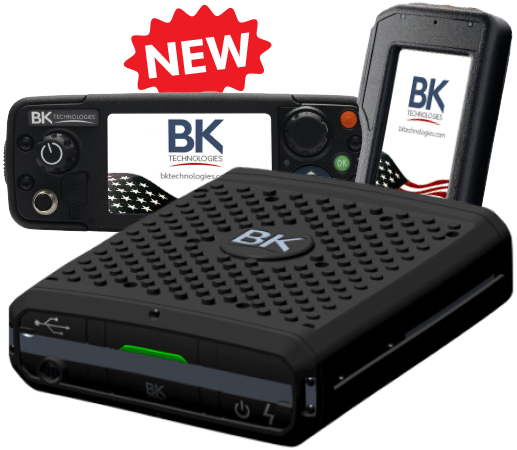
BKR9500 Series
King Radios also lists the BKR9500 remote-mount mobile platform with P25 conventional and configurable Phase 1 and Phase 2 trunked operation. It may fit vehicle or command-post requirements where a handheld alone is not appropriate.
Explore the BKR9500 mobile radio. Image source: BK Technologies; confirm manufacturer usage permission before publishing or rehost an approved copy in WordPress.
Phase 2 support should not be confused with multi-band support: the BKR5000's VHF limitation is about frequency coverage, while Phase 1/Phase 2 is about the P25 voice access method. A BKR9000 with multi-band-capable hardware is not necessarily supplied with all bands activated.
For batteries, antennas, chargers, and speaker microphones, review BKR5000–9000 accessories and the BKR accessories catalog. Exact part-number compatibility should be confirmed before purchasing.
Moving From Phase 1 to Phase 2: A Practical Upgrade Plan
The best starting point is an inventory and a system traffic review, not a purchase order for new handhelds. A radio fleet and its infrastructure must be evaluated together.
- Document today's network. Identify conventional channels, trunked sites, frequency bands, control-channel arrangements, coverage expectations, and network dependencies.
- Measure call demand. Review traffic-channel utilization, blocked or queued calls, incident peaks, and forecast growth. Establish whether capacity is actually the problem.
- Inventory subscriber equipment. Record each portable and mobile model, software version, enabled trunking mode, encryption configuration, and remaining support life.
- Check infrastructure readiness. Ask the network provider which site equipment, controllers, licensing, backhaul, and software changes would be necessary for Phase 2 traffic.
- Plan mixed-mode operation. Determine whether Phase 1-only subscribers can remain on assigned talkgroups and what fallback behavior will be supported.
- Test before deployment. Pilot the proposed subscriber configurations, emergency functions, roaming, audio, encryption, mutual aid, and failure modes on the actual system.
- Update training and documentation. Finalize code plugs, fleet templates, standard operating procedures, and an implementation schedule.
Do not confuse subscriber readiness with system readiness. Purchasing Phase 2-capable portables does not convert a Phase 1 trunking network to TDMA. The infrastructure must support and enable the relevant Phase 2 traffic resources.
What Should a Department Include in the Budget?
A quote for individual radios only tells part of the story. For an agency considering Phase 2, ask for separate costs in these areas:
- Infrastructure: system software, controllers, RF sites, repeaters/base stations, and licenses.
- Subscribers: radios that need replacement versus radios that can be upgraded.
- Feature options: trunking, band activation, encryption, authentication, and software entitlements.
- Programming and testing: channel plans, code plugs, talkgroup validation, and acceptance tests.
- Field equipment: antennas, batteries, charging stations, and vehicle installation.
- Implementation: training, dispatch changes, cutover, fallback, spares, and support agreements.
Also request a clear answer about long-term maintenance and replacement parts. A system that provides more theoretical voice paths but is expensive to support may not be the right answer for every department.
For agency purchasing assistance, King Radios provides a government communication solutions page, and its warranty information can help with ownership-cost planning.
Which P25 Phase Should Your Organization Choose?
Your conventional channels or existing trunked network meet coverage and capacity needs. Radios are supported, and there is no demonstrated traffic bottleneck.
Your trunked system regularly runs short of voice paths or faces documented growth constraints, and the infrastructure and subscriber plan can support TDMA.
Keep supported Phase 1 conventional or direct channels while enabling Phase 2 trunked traffic where it is justified and where legacy interoperability is properly engineered.
Most purchasing mistakes come from starting with a radio feature label instead of a communication requirement. A department does not need Phase 2 because the term sounds newer. It needs Phase 2 if the extra trunked capacity addresses a real system problem and the total upgrade can be supported.
If you are comparing portables, the BKR5000 and BKR9000 product pages provide different band and configuration choices. For in-vehicle applications, see the BKR9500. Confirm the final equipment list with your system administrator before ordering.
Frequently Asked Questions
What is the main difference between P25 Phase 1 and Phase 2?
Phase 1 uses FDMA and carries one voice path on a 12.5 kHz channel. Phase 2 uses two-slot TDMA for trunked traffic so that two voice paths can share the same 12.5 kHz RF channel.
Is Phase 2 always better?
No. Phase 2 is valuable where a trunked system needs more voice capacity. A conventional system or a Phase 1 trunked network with sufficient capacity may not benefit from changing.
Does a Phase 2 radio work with a Phase 1 radio?
A Phase 2-capable subscriber can generally use supported Phase 1 modes when correctly configured. A Phase 1-only radio cannot directly use Phase 2 TDMA voice and needs the system to provide an appropriate Phase 1 resource.
Can a conventional P25 channel use Phase 2 TDMA?
No. The standardized P25 Phase 2 TDMA voice mode is used for trunked operation. Conventional P25 and direct/talk-around voice remain Phase 1 FDMA.
Is Phase 2 actually two 6.25 kHz frequencies?
No. It uses one 12.5 kHz RF channel divided into alternating time slots. The phrase “6.25 kHz equivalent” describes efficiency per voice path, not two separate physical channels.
Does P25 Phase 2 improve radio range?
Not automatically. Range and coverage depend on the network's RF design, terrain, antennas, buildings, system performance, and other conditions. Phase 2 primarily adds traffic capacity.
Does the BKR5000 support P25 Phase 2?
King Radios lists the BKR5000 as P25 conventional-capable with Phase 1 and Phase 2 trunking options. It is a VHF-only portable, so its frequency band must also match the intended system.
Can I upgrade my agency to Phase 2 just by buying new radios?
No. The trunked infrastructure must support and be configured for Phase 2. Radio options, compatibility, programming, system authorization, and deployment testing also matter.
Final Thoughts
P25 Phase 1 and Phase 2 are different ways of using radio resources, not a simple division between outdated and modern communications. Phase 1 remains relevant for conventional systems, direct communication, and trunked networks that already have enough traffic capacity. Phase 2 gives compatible trunked systems a way to carry more simultaneous voice calls in the spectrum they have.
For buyers, the sound decision starts with the network: its bands, talkgroups, coverage, traffic load, and current equipment. Once those requirements are known, the right portable or mobile radio configuration becomes much easier to select.
Planning a P25 Radio Purchase?
King Radios can help you compare supported BKR configurations, accessories, and government purchasing options. For system-specific approval and compatibility, involve the network administrator or responsible radio engineer.
Call 541-621-4588 for radio and purchasing assistance.
Contact King RadiosBrowse Radio EquipmentSources and Technical References
- Project 25 Technology Interest Group — P25 FAQs, 2025 (PDF): primary explanation of Phase 1 FDMA and Phase 2 TDMA.
- APCO International — Project 25: standards process and air-interface distinctions.
- Tait Radio Academy — Phase 1 vs. Phase 2: voice capacity, battery considerations, and trunked-only Phase 2 voice.
- P25 Statement of User Needs, revised March 2024 (PDF): operational needs, interoperability, and compatibility requirements.
- King Radios — BKR5000, BKR9000, and BKR9500: product-specific capabilities. Features depend on the purchased configuration.
Technical review date: November 18, 2026. This article is a buyer's guide, not a substitute for a radio system design, manufacturer feature license, system administrator authorization, or acceptance testing. Confirm current specifications and ordering options before procurement.