
King Radios / P25 Portable Radio Comparison
BKR5000 vs. BKR9000: Which P25 Portable Radio Should You Choose?
If your department is choosing between the BKR5000 and BKR9000, start with the radio systems your people actually use. That will tell you more than the length of either model's feature list.
The BKR5000 is a VHF portable radio. The BKR9000 is a multi-band-capable portable that can be configured for VHF, UHF, and 700/800 MHz systems. Both support professional P25 communications, but they serve different operating requirements.
For a wildland fire crew working almost entirely on VHF, a straightforward single-band radio may be the right purchase. For an incident commander who needs to access regional trunked systems and channels used by neighboring agencies, the BKR9000 may be worth the extra configuration and cost.
Frequency coverage is only the beginning. Before ordering, you also need to consider P25 options, the control layout, antenna and battery compatibility, environmental protection, programming support, and the true price of a deployable radio.
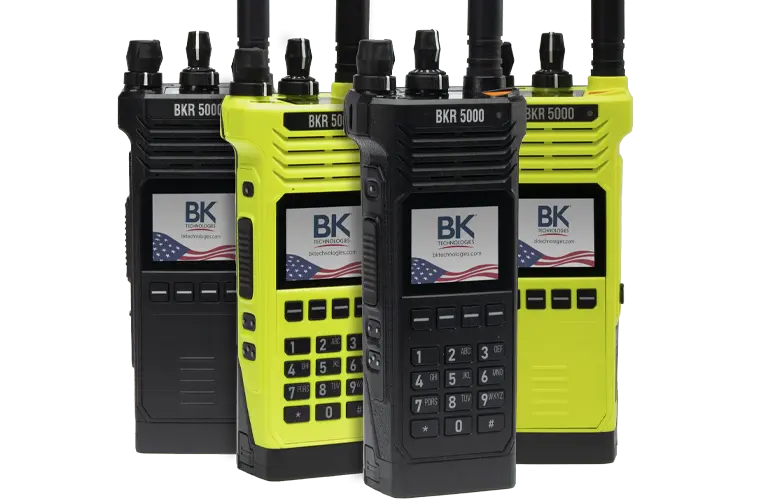
BKR5000
A focused choice for teams operating on compatible VHF networks.
View BKR5000 Radios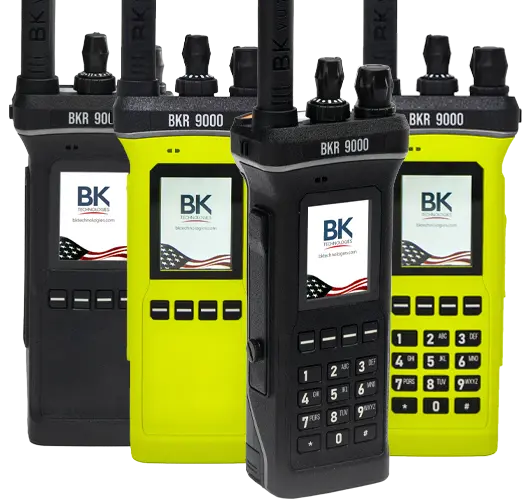
BKR9000
Designed for users who need authorized access to several frequency bands.
View BKR9000 RadiosProduct images are hosted in the King Radios WordPress Media Library. Photographs show representative control and housing configurations.
BKR5000 vs. BKR9000 at a Glance
The radios share important P25 features, but there are meaningful differences in operating bands, purchased options, environmental protection, and price. The table provides a starting point, not a substitute for checking the exact radio you intend to order.
| Feature | BKR5000 | BKR9000 |
|---|---|---|
| Frequency capability | Single-band VHF | Single-, dual-, or multi-band configurations: VHF, UHF, and 700/800 MHz |
| VHF frequency range | 136–174 MHz | 136–174 MHz when VHF is enabled |
| Other supported bands | None | UHF 380–520 MHz; applicable 700/800 MHz public-safety frequencies |
| P25 conventional | Supported | Supported |
| P25 Phase 1/2 trunking | Capable; confirm enabled options | Capable; confirm enabled options |
| Channel capacity | Up to 5,000 | Up to 5,000 |
| Maximum VHF transmit power | 6 watts | 6 watts |
| Water and dust protection | IP68 listed | IP64 standard; IP68 optional |
| Advertised battery runtime | Up to 12 hours under specified conditions | More than 12 hours on the specified 5/5/90 duty cycle |
| Standard radio-unit warranty | 2 years | 5 years |
| Primary advantage | Focused VHF operation | Broader band flexibility |
Manufacturer specifications are configuration-dependent. P25 features, band activations, accessories, and environmental ratings must be confirmed for the exact model quoted.
The practical answer: If your operation uses VHF exclusively, start with the BKR5000. If personnel must work across different frequency bands, evaluate the BKR9000—but ask exactly which bands are enabled in the price you are quoted.
Frequency Bands: The Difference That Matters Most
The BKR5000 operates on VHF from 136 to 174 MHz. It can be an effective fit for departments that already have compatible VHF conventional or P25 systems and do not require other bands.
The BKR9000 is designed to address a broader need. Its hardware can support VHF, UHF, and 700/800 MHz, with the actual operating bands determined by the purchased configuration and enabled options.
Frequency-Band Comparison
The BKR9000's band options must be activated. This graphic describes supported band categories, not communication distance or simultaneous transmission across bands.
What That Means During a Real Incident
Imagine a county fire department using VHF for tactical communications while the regional dispatch or mutual-aid system operates on 700/800 MHz. A BKR5000 cannot directly operate on that second band. A BKR9000 with the relevant band, trunking features, and authorized system programming may be able to use both networks.
That is a meaningful benefit for personnel who would otherwise carry separate portable radios. It does not mean the BKR9000 automatically connects two different networks. A multi-band portable is not, by itself, a cross-band repeater or interoperability gateway.
Multi-Band Capable Is Not the Same as Fully Enabled
BK Technologies describes the BKR9000 as multi-band-capable hardware supplied with one base frequency in its standard offering. Additional bands require the appropriate ordering choices and may carry extra cost.
Ask your dealer to identify the enabled bands on the quotation. Also confirm the correct antenna for those bands. The right radio with the wrong antenna or missing activation will not meet the requirement on the day it is deployed.
King Radios lists BKR-series antenna options that can help when planning the final equipment package.
P25 Features and Radio-System Compatibility
Both radios support P25 conventional communication and are capable of P25 Phase 1 and Phase 2 trunked operation when equipped with the necessary features. That means a VHF-based P25 department does not automatically need a BKR9000 simply because it uses digital radio.
P25 Phase 1 vs. Phase 2
Phase 1 uses FDMA, while Phase 2 trunking uses TDMA to provide greater voice-channel capacity on supported systems. A radio's ability to support Phase 2 does not guarantee that it is ready to join a specific network without programming, the relevant options, and system-administrator approval.
Can the BKR5000 Talk to the BKR9000?
Yes, when both radios are set up for compatible VHF communications. They must share the required operating parameters, and encrypted or trunked operation requires the appropriate features and authorization.
Compatibility also extends beyond frequency. If your fleet uses encryption, confirm the exact algorithms, key-management process, and system settings. If you rely on radio authentication or over-the-air features, confirm those options explicitly instead of treating the words "P25 capable" as a complete specification.
Useful purchasing step: Give King Radios or your system administrator a written summary of your current bands, conventional or trunked systems, P25 phase requirements, and authorized feature needs before selecting a model.
When the BKR5000 Makes More Sense
For organizations whose communications are centered on VHF, the BKR5000 is a compelling starting point. It provides analog and P25 operation in the 136–174 MHz range, with up to 6 watts of output and controls designed for field use.
Wildland Fire and Forestry Work
VHF remains important in many wildland fire operations. The BKR5000's physical controls, emergency function, noise-reduction features, and battery options fit the demands of crews that need predictable radio operation through long shifts.
Its rechargeable lithium-ion battery and optional AA clamshell arrangement allow departments to plan for locations where charging access may be limited. The IP68 listing is also relevant when equipment will be exposed to wet or dusty conditions.
Why More Bands Aren't Always Better
A department using only VHF may gain little from purchasing a radio configured for UHF and 700/800 MHz. Paying for flexibility that no one uses doesn't improve everyday communication.
The limitation is clear, though: the BKR5000 cannot be converted into a UHF or 700/800 MHz portable through a software-only upgrade. If your agency is planning a change of network, bring that plan into the purchase decision now.
Explore the BKR5000 P25 Portable Radio, or read our existing BKR5000 product overview for further background.
When the BKR9000 Makes More Sense
The BKR9000 is worth a closer look when access to more than one frequency band is a real part of the job. A county emergency manager, incident commander, or regional response team may need to work with agencies whose systems operate in different bands.
Multi-Agency Communications
A properly configured BKR9000 may help authorized users move between VHF, UHF, and 700/800 MHz systems without carrying multiple portable radios. But frequency coverage alone does not solve interoperability. Radio templates, assigned channels, network permissions, encryption, and the agency communication plan all have to match.
Future Network Changes
The BKR9000 may also make sense when an organization expects a move from a VHF-only system to a regional or mixed-band network. Its hardware provides an upgrade path that a VHF-only radio cannot offer.
Do not build the budget around that possibility without obtaining the actual price of additional band activations and required accessories. An upgrade path is valuable only when it is supported, available, and affordable for the intended system.
Review the BKR9000 Multi-Band Portable specifications and discuss the exact band configuration before ordering.
Displays, Keypads, and Tier Configurations
The tier names can be confusing because they refer to the radio's user interface—not the number of frequency bands that are active. A higher tier may give an operator more front-panel controls, but it does not automatically mean more transmit power or longer range.
BKR5000 Tier 2 and Tier 3
King Radios offers BKR5000 Tier 2 and BKR5000 Tier 3 VHF trunking portable listings. Compare the controls and package contents on the actual product you intend to buy.
Someone operating from a limited number of preprogrammed channels may have different needs from a supervisor using additional keypad and display functions. Standardize around your crew's procedures rather than choosing by tier number alone.
BKR9000 Interface Choices
Manufacturer product information lists Tier 1.0, Tier 2.5, and Tier 3.5 among the current BKR9000 offerings. Availability varies by color and configuration.
| BKR9000 option | What to check with the dealer |
|---|---|
| Tier 1.0 | Basic control layout; confirm current housing, display, and band choices |
| Tier 2.5 | Expanded display and programmable front-control arrangement |
| Tier 3.5 | Full keypad configuration for users who need additional front-panel inputs |
Some older descriptions use other tier naming. Verify current orderable SKUs, control layouts, and housing colors against the dealer's written quote.
Range, Battery Life, and Durability
Does the BKR9000 Have More Range?
Not necessarily. Both radios support up to 6 watts of RF output on VHF. The BKR9000's additional frequency options allow access to more bands, but they do not guarantee greater range on the same VHF system.
Coverage depends on terrain, antenna selection, repeater locations, interference, receiver performance, and system design. If your department's main complaint is poor coverage, evaluate those factors before assuming a radio swap will fix the problem.
Battery Life in the Field
BK Technologies advertises up to approximately 12 hours for the BKR5000 under specified conditions and more than 12 hours for the BKR9000 under a stated 5/5/90 duty cycle. Real battery life depends on transmission activity, battery age, temperature, and radio settings.
For multi-day assignments, spare batteries, chargers, and a field charging plan matter more than a small difference between laboratory runtime figures.
The Water-Protection Difference
BKR5000
IP68 listed. The radio is designed for demanding environments. Confirm the manufacturer's applicable test conditions for the exact unit.
BKR9000
IP64 standard; IP68 optional. If your team works in heavy rain or persistently wet conditions, request the optional protection on the quote where available.
IP64 provides dust-tight protection and resistance to splashing water; IP68 denotes a different level of water-ingress protection under specified test conditions. Don't assume that every BKR9000 is supplied with the optional IP68 rating simply because it appears in an older listing.
Batteries, Antennas, and Charger Compatibility
An upgrade can become more expensive if a department assumes its existing accessories will transfer to the new radios. The BKR5000 and BKR9000 are related products, but their batteries and other equipment are not universally interchangeable.
The standard rechargeable battery pack for the BKR5000 is identified as BKR0101, while the BKR9000 uses BKR0102. Certain approved charging systems and audio accessories may support both, but part-number confirmation is necessary.
Antennas deserve particular attention: a VHF-only antenna should not automatically be considered appropriate for a BKR9000 operating across additional bands.
Browse BKR accessories, BKR antenna options, and BKR-series chargers to plan the complete package.
Are Both Radios Approved for Wildland Fire Use?
For federal wildland fire operations and contractors, approval and support are not the same thing. This is an important distinction when choosing equipment for deployment.
The June 16, 2026 National Interagency Incident Communications Division (NIICD) Fire Approved Radio List includes both models. It lists the BKR5000 as an NIICD/NIRSC-supported VHF P25 portable. The BKR9000 is approved for relevant uses with the appropriate band option installed, but is not listed as an NIICD-supported radio.
According to the list, users of approved but unsupported radios are responsible for the programming equipment, software, training, and other support they need. For a contractor arriving at an incident, the ability to program and operate on assigned frequencies is a practical requirement—not paperwork to resolve later.
Before purchasing, check your contract or agency rules and the official NIICD documents page for the latest consolidated approved-radio list. The June 2026 approved-radio document provides the specific comparison described here.
Pricing: Compare the Whole Radio Package
The base price is useful, but agencies need to know what a radio costs when it is ready for service. King Radios currently lists these BKR5000 product configurations:
| King Radios product | Listed price (November 2026) |
|---|---|
| BKR5000 VHF Trunking Portable — Tier 2 | $2,675 |
| BKR5000 VHF Trunking Portable — Tier 3 | $2,875 |
Listed prices may change. Verify live pricing, package contents, and availability before ordering. BKR9000 pricing depends on tier, enabled bands, and options; ask for an itemized quote.
What Else Belongs in the Budget?
Include the radio, correct antenna, primary and spare batteries, chargers, speaker microphones, required software or programming services, trunking or encryption features, and any additional frequency-band activations. For a fleet, add training, replacement inventory, and long-term support.
Warranty Terms Matter
King Radios' published warranty information lists two years for the BKR5000 basic radio unit and five years for the BKR9000 basic radio unit. Batteries, antennas, and other accessories have their own terms, so compare those separately.
Check BKR9000 Lead Times
In its November 12, 2026 quarterly announcement, BK Technologies said an October production disruption had delayed some BKR9000 shipments into 2027. This does not prove any particular dealer's current inventory position, but it makes written delivery confirmation especially worthwhile for departments working to a deadline.
Read BK Technologies' production and shipment update.
For multi-unit or agency purchases, King Radios also provides government purchasing assistance.
Which Radio Should You Buy?
Start with the bands and systems personnel need today. Then weigh the controls, field conditions, approved accessories, budget, and the systems the organization realistically expects to use over the radio's service life.
Choose the BKR5000 if...
Your team operates primarily on VHF, does not need UHF or 700/800 MHz, and wants a field-ready P25 portable without paying for multi-band flexibility it does not use.
It is a strong starting point for VHF-focused wildland fire, forestry, and public-safety operations.
Explore BKR5000Choose the BKR9000 if...
Authorized personnel routinely need several frequency bands, participate in multi-agency operations on different networks, or have a well-defined future system change that justifies a multi-band-capable portable.
Confirm exactly which bands, features, and environmental options are included.
Explore BKR9000Six Questions to Ask Before You Order
- Which frequency bands and radio systems does our department actually use?
- Do personnel need access to neighboring agencies' systems or mutual-aid talkgroups?
- Are the required P25, encryption, and trunking features included and authorized?
- Which bands and antenna are supplied in the proposed BKR9000 configuration?
- What batteries, chargers, and other accessories can we safely reuse?
- What is the full deployed cost, warranty coverage, and confirmed delivery date?
These answers do more for a buying decision than comparing radio prices without checking the equipment and systems the department already owns.
Frequently Asked Questions
Is the BKR9000 better than the BKR5000?
It offers broader frequency flexibility, but that does not make it the better purchase for every team. A VHF-only department may be better served by the BKR5000.
Can a BKR5000 communicate with a BKR9000?
Yes, when both are programmed for compatible VHF communications and satisfy the necessary system and security requirements.
Does every BKR9000 come with VHF, UHF, and 700/800 MHz enabled?
No. The radio has multi-band-capable hardware, but individual orders can include fewer enabled bands. Confirm the precise band package.
Will a BKR9000 have greater VHF range?
Not automatically. Both can provide up to 6 watts on VHF. Antenna selection, network coverage, terrain, and other conditions largely determine real-world range.
Do both radios use the same batteries?
Do not assume so. Their standard rechargeable battery packs have different part numbers. Some chargers support both families; verify the equipment in your quote.
Which model is better for a wildland fire contractor?
The BKR5000 is a useful starting point for VHF-focused work. The BKR9000 may suit multi-band needs, but confirm the relevant approved configuration and your responsibility for programming and incident support.
Final Thoughts
The BKR5000 and BKR9000 are both capable P25 portable radios. The real difference is whether your organization needs the BKR9000's expanded frequency options or can accomplish its work with a VHF-focused BKR5000.
Choose around your actual operating systems, not a longer list of possible features. Verify what is enabled, what accessories are compatible, and what the complete package costs before placing the order.
Need Help Comparing BKR Radios?
King Radios can help you evaluate BKR5000 and BKR9000 configurations, accessory compatibility, purchasing options, and current availability.
Call 541-621-4588 or contact the sales team for an itemized quote.
Contact King RadiosTechnical References and Further Reading
These sources support the equipment and approval information in this comparison. Check current specifications and approval requirements before purchasing.
- BK Technologies — BKR5000 product information
- BK Technologies — BKR9000 product information
- BKR9000 official radio specifications (October 2026)
- NIICD National Fire Approved Radios (June 16, 2026)
- King Radios — Warranty information
Technical and pricing review: November 18, 2026. Product features, prices, inventory, and official agency guidance can change.